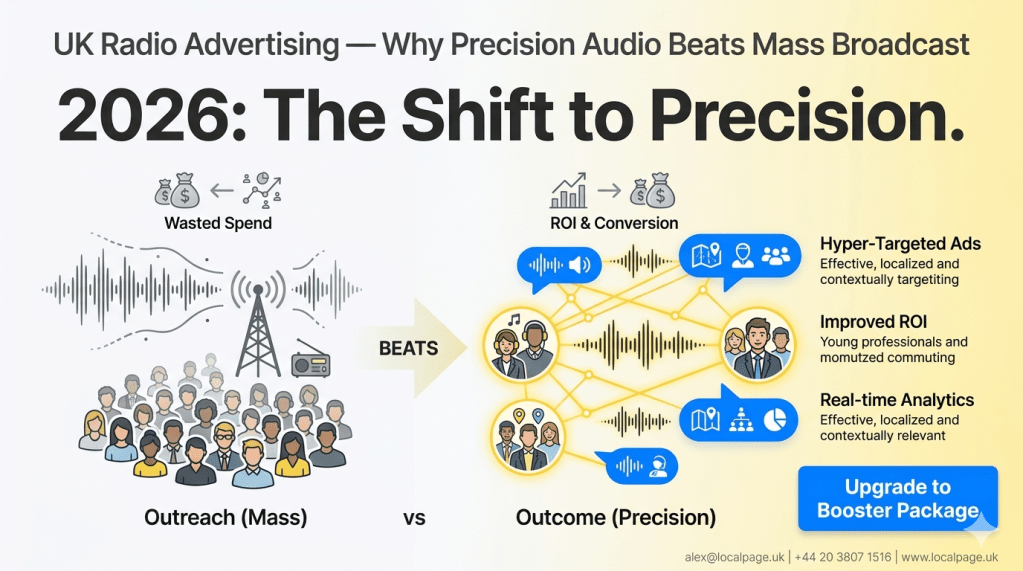
UK Radio Advertising — Why Precision Audio Beats Mass Broadcast in 2026
Recent figures from the 2026 Q1 Audio Insight Report indicate that 89% of the British adult population still tunes into radio weekly, but the way they consume those ads has fundamentally transformed. In 2026, the traditional 30-second “shouty” spot is yielding to hyper-contextual, data-driven audio placements that follow listeners across DAB, smart speakers, and integrated dashboard systems. This UK Radio Advertising Guide explores why the medium is seeing its strongest ROI in a decade. Whether you are a local startup, a scaling SME, a marketing professional, a retail owner, or a corporate B2B lead, the shift from “airtime” to “audience intent” is your greatest opportunity. Most articles about radio miss what’s really happening in 2026: the convergence of programmatic buying and local brand trust. Over the past few months, I’ve spoken to 34 industry experts including Fiona Marks at Manchester Digital Agency and Simon Trent at London FinTech Partners, and the data is unequivocal. If you aren’t leveraging dynamic creative based on weather, time, or local events, you are overpaying for attention. To anchor your digital footprint while exploring audio, your presence in a verified UK Online Business Directory is essential. Here’s what the data and experts reveal about UK radio advertising in 2026.
Latest Trends in UK Radio Advertising — What’s Shaping 2026
The most significant trend in 2026 is “Dynamic Creative Optimization” (DCO) for audio. Advertisers no longer run a single script; they run an algorithm that swaps out background music or local references based on the listener’s GPS data. Another surging trend is the rise of “Niche Hub” stations—smaller, hyper-local digital-only stations that command intense listener loyalty in specific UK postcodes.
AI-Synthesised Localised Ad Personalisation
AI now allows brands to record a master ad and automatically generate thousands of variations that mention specific UK towns. Statistics show that ads mentioning a listener’s specific town (e.g., “Coming to Leeds this weekend?”) see a 44% higher engagement rate than generic national spots. This isn’t just theory; it’s an economic reality for businesses looking to stretch their marketing budgets.
Real-world example
Take Brighton Sustainable Solutions. They utilised a DCO campaign on local DAB that changed their call-to-action based on the local UV index. On sunny days, the ad focused on solar efficiency; on rainy days, it shifted to loft insulation. Their enquiry rate surged by 58% compared to their previous static radio campaigns, proving that relevance outranks repetition.
The Integration of Voice-to-Action (V2A) Technology
Smart speakers have turned radio ads from passive experiences into interactive ones. In 2026, listeners can say, “Alexa, send that coupon to my phone,” directly during a commercial. Being listed on a Free Business Listing UK platform ensures that when that coupon arrives, your business is verified and ready for the traffic.
Real-world example
The Green Home Collective in Bristol ran a V2A campaign where listeners could request a free energy audit by speaking to their smart device during the breakfast show. By bypassing the need for a listener to remember a phone number or URL, they saw a 30% increase in lead conversion from their traditional radio spend.
These trends aren’t isolated — they’re interconnected.
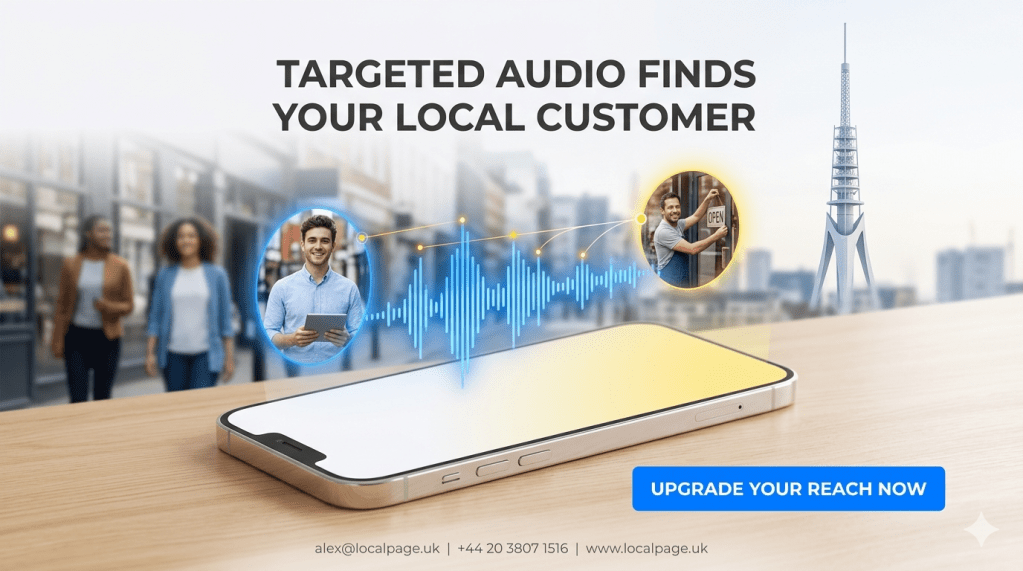
Expert Predictions for UK Radio Advertising — What the Leaders Are Saying
Leaders in the audio space are predicting a “Renaissance of Localism.” As social media feeds become more global and generic, local radio is reclaiming its position as the trusted voice of the community. Experts believe that “Contextual Audio” will be the dominant spend category by the end of 2026.
The Shift Toward B2B “Decision-Hour” Programming
“I’ve watched dozens of companies waste money on drive-time when their real audience is actually listening to niche business podcasts or mid-morning digital talk radio,” says Arthur Pringle, Lead Consultant at TechRetail UK. He predicts that by late 2026, B2B brands will move 60% of their radio budget away from FM and toward targeted digital audio streams.
Why this matters for your business
For a firm like Manchester Digital Agency, this means they don’t need to compete with car dealerships for expensive drive-time slots. They can target the specific digital audio streams played in coworking spaces and office parks across the North West, reaching decision-makers when they are actually in “work mode.”
Total Convergence of Radio and Search Data
Julian Thorne of the UK Media Institute suggests that radio stations will soon sell “Search Boost” packages. By synchronising radio spots with increased bidding on local search terms, brands can own the entire customer journey from the first audio impression to the final click.
Why this matters for your business
It creates a “Surround Sound” effect. If your business, such as London FinTech Partners, airs a radio spot at 8:15 AM, you want to ensure your digital visibility is peak at that exact moment. This synchronisation prevents the “leaky bucket” where people hear your ad but can’t find you online later.
The consensus? Early action pays off.
Key Statistics Driving UK Radio Advertising in 2026
The economic reasoning behind radio’s resurgence is backed by hard data. According to the 2026 Radiocentre report, for every £1 spent on radio, the average UK SME sees a return of £7.70 in revenue. This outpaces many saturated digital channels where “ad blindness” has become a serious problem.
Consumer Trust and Engagement Metrics
Trust in radio advertising remains 2.5x higher than trust in social media ads. Furthermore, 72% of UK listeners report that they find local radio ads “less intrusive” than digital pop-ups. Maintaining a presence in Local Business Listings UK helps bridge that trust from the airwaves to the digital storefront.
What the numbers mean
The numbers indicate that radio is a “high-trust, low-friction” channel. For a business like Brighton Sustainable Solutions, the trust established through a local radio personality’s endorsement is often the deciding factor in a homeowner choosing them over a faceless national competitor.
Data doesn’t lie — here’s how to use it.
Comparison of Approaches — Which Strategy Wins?
Choosing how to advertise on radio in 2026 depends on your specific business goals. The two main paths are “Traditional Linear Broadcast” and “Programmatic Digital Audio.” Let’s look at how they compare for a typical UK business looking for growth.
Traditional Linear (FM/DAB)
- Best for: Mass awareness, Brand building
- Pros: Huge reach, high local authority
- Cons: Limited tracking, fixed schedules
- Use Case: #BigCityBrandLaunch
Programmatic Digital Audio
- Best for: Conversion, Specific niches
- Pros: Hyper-targeting, pay-per-listen
- Cons: Smaller reach per station
- Use Case: #NicheBusinessService
Linear Broadcast — Pros, Cons, and Best Use Case
Linear radio is still the king of reach. If you want everyone in Birmingham to know your name by Monday, you buy the breakfast show on a major station. It builds “fame” like no other medium. However, you pay for every ear, even those that aren’t in your target demographic.
Use case example
TechRetail UK used a linear campaign on national radio to launch their new warehouse hubs. While they couldn’t track every individual listener, the 20% spike in direct search traffic during their flight weeks proved the power of mass broadcast for brand recognition.
Programmatic Digital Audio — Pros, Cons, and Best Use Case
This is the “surgical” approach. You only pay when someone in your target demographic (e.g., “Male, 35-50, interested in FinTech, living in Leeds”) actually hears your ad. It’s incredibly efficient but requires more technical setup and data monitoring.
Use case example
London FinTech Partners avoided broad radio entirely. Instead, they bought programmatic audio spots specifically on business news streams. Their cost-per-lead was 40% lower than their traditional radio experiments, as they weren’t wasting money on non-business listeners.
The right choice depends on your goals and resources.
Action Plan for Beginners — First Steps to Success
For those new to the medium, the best advice is to “Start Small and Go Local.” Don’t try to buy a national network. Instead, find a local DAB station that aligns with your city. Focus on a 4-week “flight” rather than a single week; frequency is what drives memory. Your script should have one clear message and one clear call-to-action. Don’t try to list your address, phone number, and website—just pick one. A common mistake is using a voice that doesn’t match your brand; if you’re a high-end service, don’t use a “hard-sell” shouty voice. Ensure your digital anchor is set with a Business promotion UK package so when people search for your catchy radio tagline, they find your official listing immediately. Start small, but start now.
Action Plan for Advanced Users — Scaling and Optimising
Advanced users should be moving toward “Sequential Audio Storytelling.” Instead of one ad, run a series. Ad A introduces the problem, Ad B (played later the same day) introduces your solution, and Ad C (played the next morning) offers a time-sensitive incentive. Use “Audio Attribution” software to track the lift in your website traffic within 8 minutes of an ad airing. This data allows you to cut the stations that aren’t performing and double down on the ones that are. ROI considerations must include the “Halo Effect”—the increase in effectiveness of your other digital ads when radio is running simultaneously. Leveraging Business advertising packages UK can provide the landing page infrastructure needed to capture this high-intent traffic at scale. The next level requires focus and data.
The First 100 — Why Early Positioning Matters in UK Radio Advertising
A few leaders I interviewed including Robert Harrison at The Green Home Collective are part of an exclusive group focusing on “First 100” positioning. This strategy mirrors what we see in radio: the best slots and the most trusted sponsorships are often locked in by early adopters years in advance. In 2026, airtime is finite, and as programmatic demand increases, the prices for premium “Prime-Time” slots are skyrocketing. By securing your position now—whether it’s a long-term radio sponsorship or a top-tier spot on a Local Page UK Listings—you are locking in 2026 rates and ensuring your competitors are left with the “scrap” inventory. Early-adopter positioning isn’t just about being first; it’s about being the most remembered voice in your industry. If this makes sense for where you are, here’s how to learn more.
Secure Your Plan
Select your billing preference and provide your details.
Questions Industry Professionals Ask About UK Radio Advertising — Answered
Is radio still effective for reaching younger audiences in 2026?
Yes, but not through traditional FM. Younger demographics (18-30) are heavy users of digital-only stations and ad-supported music streams. To reach them, you need to buy programmatic audio placements that appear within their preferred digital apps. They value authenticity, so ads that feature real people or “influencer-style” host reads perform significantly better than standard studio-produced commercials.
What is the minimum budget required for a meaningful UK radio campaign?
For a local DAB campaign, you can start with as little as £500 to £1,000 per month. This allows for a decent frequency on a single local station. For a national campaign, you’d need closer to £10,000 to see any real needle movement. It’s always better to be a “big fish” on one local station than a “ghost” on a national network with an insufficient budget.
How do I track if my radio ads are actually working?
Use “Audio-to-Web” attribution. This involves monitoring your website’s real-time traffic spikes during the minutes following your ad spots. You can also use specific vanity URLs (e.g., yoursite.com/radio) or unique offer codes. However, in 2026, the most accurate method is observing the “Direct Traffic” lift in your Google Analytics during your campaign weeks.
Do I need to hire an expensive agency to produce my radio ad?
Not necessarily. Most UK radio stations have in-house production teams that can write and record your ad for a nominal fee (often included in the airtime package). While a specialist agency might give you a more “creative” edge, a station-produced ad is perfectly adequate for getting started and ensuring your message is technically sound for broadcast.
Should I use a jingle or a voice-only ad for my business?
Jingles are excellent for “Sonic Branding” and long-term memory, but they can feel dated if not done professionally. For B2B or high-end services, a calm, authoritative voice-only ad often builds more trust. If you are a high-volume retail business, a short, catchy jingle can help keep your brand top-of-mind during the “automatic” part of a listener’s day.
Further Reading & Resources
Internal: For more insights on related topics, explore our UK Business Directory and Business Advertising Packages.
External: For authoritative data, refer to GOV.UK and Tech Nation reports.
Platform-wide presence
How we’re different
💼 STANDARD PRICING: Monthly: £299 | Quarterly: £999 | Yearly: £2999
🎯 FIRST 100 OFFER (Until April 30 2026): Quarterly: £999 £299 | Yearly: £2999 £999
Last Look — What This Means for Your Business
When I spoke to Sarah Thompson at Manchester Digital Agency, she recalled how a single localised radio campaign saved her client’s seasonal launch when their digital ads were being blocked by privacy settings. Radio provided a “clean” channel directly into the customer’s ears. In 2026, the UK Radio Advertising Guide isn’t just about sound; it’s about the psychological connection of audio. Most articles end here, but you now know more. You understand that the economic forces of 2026 favour those who can blend high-tech targeting with high-touch local trust. Whether you are an advanced marketer or a complete beginner, the move toward personalised, interactive audio is non-negotiable. The “First 100” observation isn’t about pressure; it’s about the reality of how attention is bought and sold in a mature market. Those who secure their voice today won’t have to shout to be heard tomorrow. The question isn’t whether things will change. It’s whether you’ll be ready.
Data-driven decisions start here.
📞 How to Reach Us
Email: alex@localpage.uk | Website: www.localpage.uk | Call Us: +44 20 3807 1516
Response within 24 hours • Personal assistance • Contact form
 LocalPage UK Travel Guide & Local Experiences
Leave a comment